
Improving the management of diabetic foot conditions
Foot complications are very common in patients with diabetes. At least one in six diabetics develop foot ulcers at some point in their lives. This article reviews why foot complications occur in diabetes, how you can detect foot problems early, and treatment and prevention strategies. The National Service Framework for Diabetes suggests that targeted foot care for people at high risk could save hundreds of amputations a year. By detecting complications earlier, we can make a real difference to patients’ lives, reducing morbidity, improving quality of life and even saving limbs.
Optimising lipid levels: looking beyond LDL-cholesterol
Treatment with statins is undoubtedly making a major contribution to reducing high-risk patients’ chance of a heart attack or another coronary event. However, their risk remains high, since over half of patients included in statin clinical trials suffered a further coronary event within five years. There is growing evidence that we need to move beyond simply lowering low-density lipoprotein cholesterol (LDL-C) and optimise the whole lipid profile.
Back to Basics: A BJPCN Guide – Erectile dysfunction

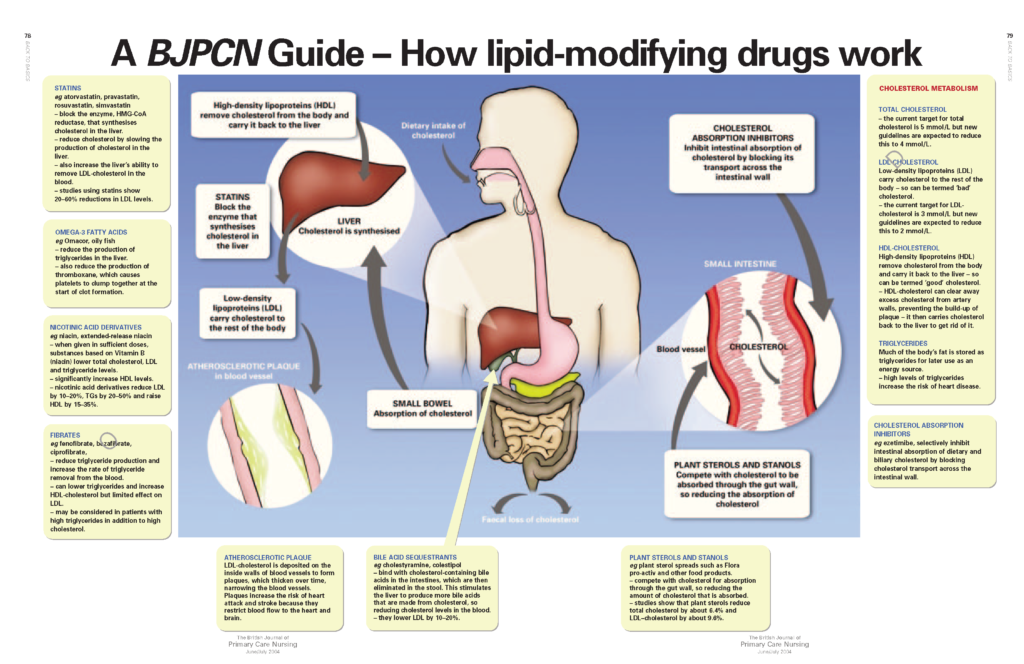
Non-statin strategies for modifying lipids
Raised cholesterol is the commonest risk factor for CHD. Reducing cholesterol can be an effective way to help lower a patient’s risk of heart disease, particularly when cholesterol levels are already high. Dr Rubin Minhas looks at how to help patients to lower their cholesterol levels without drug treatment. He will discuss other lipid modifying drugs in future issues.
New year’s resolutions: take one small step at a time
It’s that time of year again. New Year – time for resolutions, many of which are associated with health. Personal New Year’s resolutions are often about losing weight, getting fit or eating more healthily. All good news for cardiovascular health, the focus of BJPCN. But, as primary care nurses, we could have broader new year’s resolutions, affecting our clinical practice and efforts to improve the health of our patients. Persuading anyone – including ourselves – to change behaviour in an effort to improve health can be challenging at the best of times. The answer seems to be to just take one small step at a time – one that you know you can repeat with ease. Don’t attempt a revolution. In this issue, we offer a range of ideas that you could adopt as ‘new year resolutions’ for your practice – or even yourself!
Ezetimibe: a new type of lipid-lowering therapy
Only half of patients being treated for elevated cholesterol levels are currently reaching targets, according to recent research. So what can we do to improve things? One option is to add a new type of lipid-lowering drug – ezetimibe – to a statin. This article reviews how ezetimibe works and its place in primary care management of raised lipids.
Raising the issue of obesity with patients who need to lose weight
You know the scenario only too well. Your patient is sat in front of you, taking up more space than he or she used to, and you are discussing the increase in their blood glucose levels. How do you raise the issue of their weight, without offending them or making what seems to them a personal comment?