You may have thought you were safe from dire warnings about global warming in the pages of BJPCN. But hayfever is one of the themes of this issue and the mild winter has meant that some people suffered symptoms much earlier than usual as pollens which can trigger allergic reactions were found in the air as early as January.
Anxiety in Patients with Respiratory Disease
Anxiety is a significant problem for many patients with respiratory disease and can have
a very negative impact on the disease course and prognosis. Practice nurses have an
important role to play in identifying anxiety and referring patients for appropriate
treatment. This article will focus on anxiety in such patients and aims to help you
understand what anxiety is, how anxiety affects patients, how to recognise symptoms of anxiety
and how to use the Hospital Anxiety and Depression Scale. A second article, to be published in
the next issue, will focus on management of anxiety.
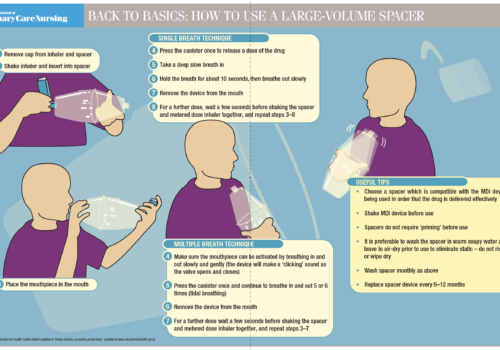
Back to Basics: How to use a large-volume spacer
Thunderstorm Asthma

On 23 June 2005, the Met Office issued a warning that severe thunderstorms were likely
to hit the South East of England in the next 24 hours. On the evening of Friday 24 June,
primary care out-of-hours services and hospital accident and emergency departments
in Northwest London were inundated by patients attending with acute asthma. The
scale of these attendances – eight times more patients than usual in one hospital – meant that
departments had to call in additional staff and some ran out of emergency supplies of
bronchodilators, nebulisers and oral steroids for treating asthma. In this article, we will explain
the background and some of the theories related to this type of epidemic of acute asthma –
Thunderstorm Asthma.
Scoring top marks for smoking cessation

This year, as 1 July and ‘no smoking in public places’ approaches in England, many more
patients will want help to stop smoking. Practices in Scotland and Wales are already
facing this challenge. How do we optimise the smoking cessation advice we offer at the
same time as juggling the many other responsibilities we have? In this article, we look at
how to score top marks for Quality and Outcomes Framework (QOF) indicators on smoking
cessation – recording information and offering advice that will help patients to quit as well as
gaining extra payments for our practices.
Making Sense of Drug Allergy: What Goes Wrong and Why
Allergic or other immunological mechanisms are thought to account for 6-20% of
all adverse drug reactions, but in most cases the mechanism is unclear. This
article provides an in-depth review of drug allergy – adverse drug reactions with
a known immunological mechanism or with clinical features that mimic an
immunological reaction.
Editorial: Spring
Was it me? Did I blink and miss the spring? There I was, trying to plan my
early initiation of inhaled steroids and nasal sprays to ward off seasonal
exacerbations of allergic rhinitis and asthma but spring just doesn’t seem
to have sprung this year! It made me wonder whether the wet weather
had an influence on hay fever levels.
Anticholinergics: How do they Work?
Anticholinergic drugs are bronchodilators that act by blocking acetylcholine, the
neurotransmitter for the parasympathetic nervous system. By blocking parasympathetic
stimulation, anticholinergics reduce cholinergic tone, therefore producing
bronchodilation. In this article we review when and how these drugs should be used.
What are their potential benefits and what should we tell patients who need them?
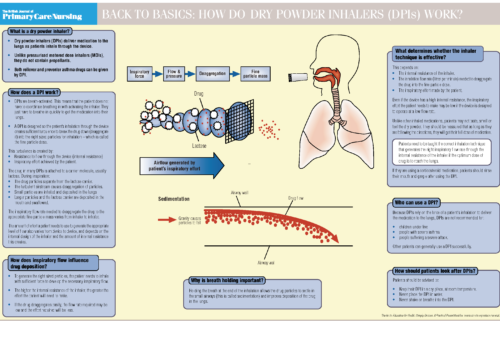
Back to Basics: How do dry powder inhalers (DPIs) work?
The role of Beta2 agonists in managing asthma

Beta agonists are the only class of drugs that is recommended for the management of
asthma at every level of current guidelines, including those from the British Thoracic
Society (BTS). This means that they are used across the spectrum of severity of
asthma, from mild intermittent disease (step one) to severe asthma symptoms (step
five). In this article, we take you through the key things that you – and your patients – need to
know about these drugs.
Rhinitis: Successful Diagnosis and Management
Runny, blocked noses are a common problem in the winter months, accounting for a
substantial number of general practice consultations. Successful treatment depends
on identifying the correct cause of the symptoms. In this article we give you key
information on rhinitis – what it is, how to diagnose it and how to treat it successfully.
Is Immunotherapy an Option for my Patients with Severe Seasonal Allergic Rhinitis?
Severe seasonal allergic rhinitis (hayfever) has a significant impact on sufferers’ quality of life
and productivity, and can be a challenging condition to manage in primary care. As a majority
of these patients have poor or only partial symptom control in primary care, they may be
suitable for referral to secondary care. Some of these patients may be appropriate for
treatment with specific allergen immunotherapy and this article reviews the impact of severe seasonal
allergic rhinitis and highlights recent data on the effectiveness of sublingual immunotherapy.