
The new NICE guideline enables us to individualise care bearing in mind the needs of the person in front of us. It is concerned with clinical efficacy, and – for once – the cost of care has not noticeably influenced its recommendations. In contrast, QOF does the exact opposite, demanding that we drive our patients’ HbA1c down to low […]
Advances in cardiac computed tomography: an update for primary care physicians
When to use aspirin in the primary and secondary prevention of cardiovascular disease: acting on the latest evidence
Chronic kidney disease, estimated glomerular filtration rate and the Quality and Outcomes Framework: a survey of GPs in the UK
International expert committee recommends new role for HbA1C in diagnosing diabetes
A commentary on the NICE guideline on identification and management of familial hypercholesterolaemia
Making sense of triglycerides
Antibiotic prophylaxis against infective endocarditis
Navigating the new NICE guideline on type 2 diabetes: Finding the best treatment pathway for each patient
Chronic kidney disease: Helping practices to identify patients at risk and reduce progression
Chronic kidney disease (CKD) has moved rapidly up the healthcare agenda over the last few years. It has shifted from being considered as a rather nebulous condition of interest mainly to nephrologists to the front line of chronic disease detection and prevention in primary care as part of integrated management of vascular risk. In fact, […]
Back to Basics: Urine tests for renal function
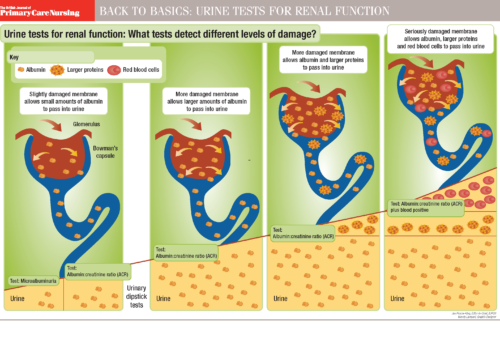
Urine tests for renal function: What tests detect different levels of damage?
Venous thrombosis and thromboembolism
Venous thromboembolism (VTE), comprising deep vein thrombosis (DVT) and pulmonary embolism (PE), is a major public health problem affecting around 100 per 100,000 population per year and causing thousands of deaths annually. Large population-based studies have shown that factors associated with hospitalisation account for half of the attributable risk of VTE.